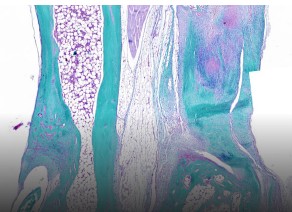
Musculoskeletal injuries, including tendon and ligament trauma, can lead to ectopic bone formation near the site of injury, and there are few effective treatments available to prevent this traumatic heterotopic ossification (HO). Here, Jiang et al. found that myeloid cells deposit extracellular traps (ETs) at sites of HO in humans and mice. Using genetic loss-of-function and gain-of-function studies in mice, the authors show that ETs are associated with HO severity. In preclinical models, treatment with ET-disrupting drugs in the acute phase after tendon injury reduced HO incidence without systemic effects on bone volume. This study provides evidence that ETs contribute to the development of traumatic HO and that ET-disrupting therapeutics warrant clinical evaluation for prevention of HO. —Molly Ogle